|
Shri Mr. Tarun Vijay, Member of Rajya Sabha of India,
Mr. Pradeep Rawat, Joint Secretary of East Asia Division, Ministry of External Affairs of India,
Mr. Venu Rajamony, Press Secretary to President of India,
Mr. Taer Ga, Deputy Director of Foreign Affairs Office of Tibet Autonomous Region,
Distinguished Guests, Ladies and Gentlemen,
Namaste!
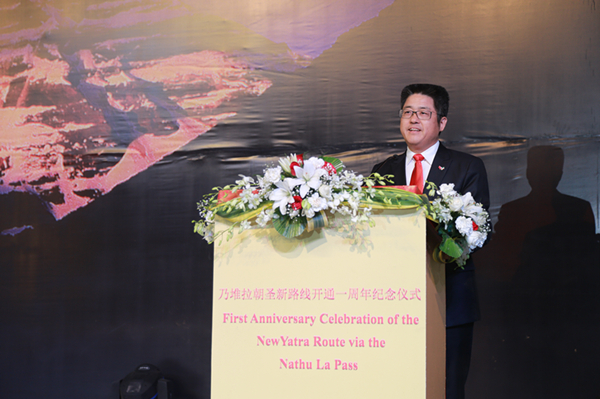
With the smell of colorful Holi festival still in air, we gather here in the Chinese Embassy to celebrate the first Anniversary of new Kailash Manasarovar Yatra route via NathuLa pass. I’d like to extend my sincere thanks and warm welcome for your presence.
As you all know, in the Ali area of Tibet Autonomous Region, lie a holy mountain Kailash and a sacred lake Manasarovar. Kailash Manasarovar is believed to be the residence of Lord Shiva, where he sits in a state of perpetual meditation and takes the stairway to heaven. Positioned at the very center of the Universe, it is acclaimed as King of Mountains and Mother of all Rivers. Since ancient times, it has been the Holy Mountain and Sacred Lake in the minds of Hindus. For many years, Indian Yatris climb up hills and wade over waters through Qiangla Pass to Kailash Manasavoar, which is not only inconvenient but also unsafe. In this sense, opening a more comfortable and safer Yatra route via Nathula Pass becomes an aspiration of all Indian Yatris.
In September 2014, Chinese President Xi Jinping and Indian Prime Minister Narendra Modi reached an important consensus on opening a new pilgrimage route of Kailash Manasarovar Yatra through Nathula Pass. With media’s blanket coverage, Nathula pass became well-known overnight. I was honored to witness that historic moment. Right upon that moment, countless work has been done for the opening of new route by Chinese Ministry of Foreign Affairs and Indian Ministry of External Affairs as well as local governments. Authorities in Tibet Autonomous Region put in great efforts to build hotels, reception centers and washrooms, to prepare Yatra bus and to train guides and so on. On June 22, 2015, after 9-month tireless preparation, a grand opening ceremony was held on the Chinese side of Nathula pass. The first batch of 50 Yatris walked through the pass, setting foot on their long-expected new Yatra route.
On behalf of Chinese Ministry of Foreign Affairs, I took the journey to Nathula pass through Sikkim to pave the way for the Yatris, becoming the first Chinese passport-holder to go through Nathula pass. The new route from Nathula pass to Kailash Manasarovar spans about 2000km, but the Yatris needn’t risk their lives on the way as before. Sitting comfortable in air-conditioned buses by a maximum speed of 120 km per hour, they can take the pleasure of enjoying the heavenly beauty and grace of the splendid landscapes. The trip to Kailash Manasarovar is no longer tough, but more pleasant and convenient, full of happiness and enjoyment.
I’d like to note that my good friend Mr. Tarun Vijay also joined the first batch of Yatris through Nathula pass. In his book “An Odyssey in Tibet: A Pilgrimage to Kailash Manasarovar”, he vividly describes his previous experience of Yatra and mentions that the trip to Kailash Manasarovar is not a pure pilgrimage, but a dream of generations and highest life ideal to come true. Life would be far from meaningful without one such Yatra. Having covered the journey from Nathula pass to Kailash Manasaroar, I personally felt that my mind was purified and my soul sublimed. I have gathered deeper understanding towards the Indian Yatris’ persistent spirit of devotion, and the political significance of the consensus reached by the leaders of two countries to open the new Yatra route through Nathula pass. Yes, the Nathula pass serves as not only a route of pilgrimage, but also a route of friendship and cooperation between China and India. Crossing the Himalayas, this “Sky Path” will go down in history as another milestone in the people-to-people exchanges and friendship between our two countries.
Ladies and Gentlemen, my dear friends,
This year’s Kailash Manasarovar Yatra will see an increased quota of 7 batches and 350 Yatris via Nathula pass, and we will expect more in the coming years. The Yatra has been so popular among Indian people that not every applicant could make it. For people who cannot join the Yatra, the government of Tibet Autonomous Region has made several kinds of souvenirs with the mark of Kailash Manasarovar, which will be later unveiled. Tibet and India are connected by mountains and rivers. Beautiful Tibet beckons more Indian Yatris and tourists to explore the numerous amazing scenic spots apart from Kailash Manasarovar.
The new Yatra route through Nathula Pass has been operated for one year, in which I can sense that between our two peoples communication is being enhanced and perception gap being narrowed. The year of 2015 witnessed an increase of 21% Chinese tourists visiting India after Prime Minister Modi announced issuing e-visa for Chinese nationals, and the number of bilateral exchanges exceeds 1 million for the first time ever. At the beginning of 2016, China attended Delhi International Book Fair as Guest of Honor and launched a grand ceremony of “Visit China Year” in Delhi, which created a strong wave of China Wind. All of these attest to the bright future of people-to-people exchanges between two countries.
As we gather here tonight to mark the first Anniversary of the new Yatra route via Nathula Pass, we are committed to enhancing cultural and people-to-people exchanges, to injecting stronger and much more energy into China-India relations, and to laying more solid social foundation between our two peoples.
To conclude, let us join hands together to build a better future for China-India relations.
Dhanyavaad!
|